
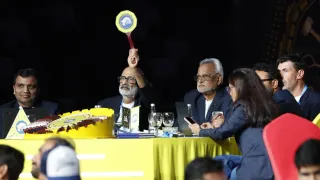
Chennai Super Kings’ decision to spend a combined INR 28.4 crore on two uncapped teenagers at the IPL 2026 auction marked a clear departure from the experience-first philosophy that had underpinned the franchise for nearly two decades. And head coach Stephen Fleming has openly acknowledged that the shift was overdue.
Reflecting on CSK’s aggressive bidding for 20-year-old Prashant Veer and 19-year-old Kartik Sharma, Fleming conceded the franchise may have been “a little bit slow” to adapt to the rapid evolution of the T20 game.
The rethink, he explained, began midway through a difficult IPL 2025 campaign. Signings such as Dewald Brevis, along with uncapped youngsters Ayush Mhatre and Urvil Patel, injected belated energy into a top order that had struggled to match the tempo set by rivals. CSK finished bottom of the table, but Fleming said the lessons learned proved decisive in shaping their strategy at Tuesday’s auction in Abu Dhabi.
“As the game has evolved, we might have been a little bit slow to evolve with it,” Fleming said. “Only halfway through last season did we make a big shift, and you could see that change in the players we brought in as reserves.
“Sometimes you hold on to theories and philosophies because of past success, but we realised we needed to move. The work we started last season has allowed us to continue in that direction now.”
Veer and Kartik, along with Mhatre and Urvil, represent what Fleming described as a new generation of “T20 babies” — players raised on the format, shaped by local leagues, and unburdened by the traditional pathways of age-group and domestic cricket. Unlike earlier generations, Fleming believes these players play with instinct rather than hesitation.
“We’re now seeing the product of T20 really come to the fore,” he said. “I used to think experience would always win, but now you’ve got these fearless athletes who’ve grown up on T20 cricket. They’ve got mouthwatering skillsets and no fear about where or how to show them.
“Experienced players can sometimes get caught analysing where the game is going. These young guys only know one way — they’re free, they’re expressive, and as the game gets faster, they seem to thrive.”
The philosophical shift wasn’t limited to the auction table. Ahead of the bidding, CSK made another bold call by trading franchise icon Ravindra Jadeja — a 200-game veteran in yellow — to Rajasthan Royals in exchange for wicketkeeper-batter Sanju Samson. Fleming framed the move as both a tactical upgrade and a long-term investment, particularly with MS Dhoni nearing the end of his storied career.
“The opportunity was there,” Fleming said. “We felt we were still a little light at the top, and we also know that at some point MS will move on.
“Sanju is an international-quality player who fits that role really well. It’s succession planning — not just looking at what Chennai will be in two years, but six years down the line. We’re refreshing the squad with that bigger picture in mind.”
For a franchise built on stability and continuity, CSK’s pivot towards youth marks a significant evolution — one that suggests even the most successful teams must keep pace with a game that refuses to stand still.
