
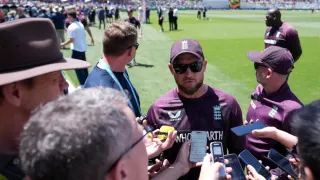
Brendon McCullum has conceded that England’s preparations for the Ashes warrant serious reflection after the series slipped away in barely 11 days, with two Tests still left to play.
Speaking after Australia sealed a dominant 82-run win in Adelaide to move 3-0 ahead, England’s head coach was frank in his assessment. Australia, he said, had been superior in every department, describing their performances as precise, formidable and relentlessly consistent — qualities England struggled to match throughout the contest.
Despite a spirited last-day resistance in Adelaide, England were left lamenting missed opportunities. Chasing a record 435 to keep the series alive, they recovered from 194 for 6 to post 352 — their best total of the series and their highest in Australia since 2017. It was a fight that arrived too late.
“We’re hugely disappointed,” McCullum said. “We came here with big ambitions and we haven’t delivered. Across three Tests, Australia have been better with bat, ball and in the field. When that happens, you have to own it.”
He acknowledged that England failed to seize key moments. The bowling lacked sustained accuracy, the batting never quite found the right tempo, and costly chances were missed in the field. Even when England briefly surged — such as bowling Australia out cheaply on the fourth morning — the damage had already been done.
Much of the post-series analysis is now expected to focus on England’s preparation, particularly ahead of the first two Tests. Their lone warm-up match was played on a slow Perth surface that offered little resemblance to conditions at Optus Stadium, while a decision to skip a pink-ball fixture against the Prime Minister’s XI was followed by an intense training block before the second Test — after which McCullum famously said England had “over-prepared”.
“When you lose 3-0, you have to put your hand up and say maybe you didn’t get it right,” McCullum admitted. “As coach, you’re responsible for how the team is prepared. Looking back, should we have done more before the first Test and less before the second? Those are fair questions.”
He stressed that the preparation was undertaken with conviction, based on what had worked in the past. But the outcome left little room for deflection. “Sitting here at 3-0, it didn’t work,” he said.
While England’s batting remained flawed — no centuries despite several starts — McCullum drew some encouragement from the way the team finally played with freedom late in the Adelaide Test.
“The last day and a half, maybe two days, was probably our best cricket,” he said. “Before that, we were so desperate to succeed that we almost got in our own way. Only at the end did we let go and actually play.”
That realization, he said, was a lesson not just for players but for the coaching staff as well: how to unlock freedom under maximum pressure, rather than only once the result is gone.
McCullum rejected the idea that England were blindsided by the intense scrutiny surrounding the Ashes, but conceded the weight of expectation had constrained his players. In trying too hard to live up to the moment, they tightened rather than thrived.
Compounding the challenge was England’s lack of experience. Aside from Joe Root and Ben Stokes, few in the squad had previously played Tests in Australia, and injuries further depleted their resources.
“We knew experience-wise Australia had the edge,” McCullum said. “You hope youth and enthusiasm can balance that, but under pressure decision-making can blur. I thought we were clear on how we wanted to play, but maybe we got stuck.”
Now, with the Boxing Day Test looming, McCullum insists the tour still has meaning. England have not won a Test in Australia since 2011, and pride is firmly on the line.
“There’s still a great opportunity in the next two Tests,” he said. “We need to take something from this tour — for ourselves, for the supporters here, and for those back home.”
Asked whether England can realistically win in Melbourne, McCullum was clear: only if they free themselves mentally.
“If we let the pressure and the scoreline weigh us down, then no,” he said. “But if we just play, immerse ourselves in what needs doing, and allow talent to come out under pressure, then anything is possible. That’s the message now.”
