
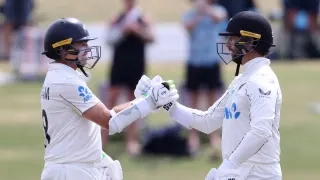
Bay of Plenty truly delivered for New Zealand. Devon Conway and Tom Latham each scored a century, and once they got into their rhythm, it seemed nobody else even got a chance at the crease. West Indies arrived in Mount Maunganui chasing a historic first Test win here in 30 years, hoping to claim a share of the series spoils. But as the day went on, Roston Chase and his teammates gradually faded into the background.
At this ground, every previous five Tests had seen at least one wicket fall in the first session. This time, there was none. Kane Williamson, used to starting early, had to wait longer than ever to “clock in.” By the start of the final session, he was seen fully geared except for his helmet, practicing rapid-fire leaves and blocks, almost theatrically. Imagining split-screen reels of Conway and Latham facing real balls, the question of “who did it better” might come up—but the classic answer remains Terry Jarvis and Glenn Turner.
Latham was central to history. Across 25 home Tests since March 2012, New Zealand rarely chose to bat first. Here, he trusted his instinct to put runs on the board, and beyond that bold call, his play was textbook: close to the body, aware of his off stump, frustrating bowlers to attack pads, and creating easy scoring opportunities. Latham’s 15th Test century, surpassing 6,000 runs as an opener, was proof that cricketing fairy tales can be built from technique alone. He finally fell for 137, and New Zealand nearly had a full day with their opening pair unbroken.
Conway found his form steadily. In 26 of his previous 39 innings, he had failed to pass 30, far from ideal for a top-order batter. Walking onto a pitch with unusually thick grass—13mm compared to the typical 7-10mm—he faced initial challenges. But he weathered them, taking charge in the eight overs before morning drinks where West Indies conceded only 11 runs. He orchestrated New Zealand’s first dominant period and batted longer than he had since his debut double century at Lord’s four years prior.
West Indies technically won the toss but failed to capitalize. Anderson Phillip, their third seamer, began with figures of 3-0-25-0, but despite creating a rare chance when Latham edged at 104, nothing came of it. The bowling attack produced moments of brilliance but lacked the consistency to trouble disciplined batsmen.
The second session was no easier. Boundaries came freely, five off twelve balls, as a brief shower gave West Indies a chance to regroup. Jayden Seales tried a short-ball strategy reminiscent of Neil Wagner. Conway was hit on the left hand and required medical attention, even asking the umpire about tea time over the stump mic. Seconds later, Chase floated a long-hop that Conway pulled for four. West Indies repeatedly undone their own work.
This was no batting paradise, nor a fast bowler’s dream. In the previous first-class game here, spinners had taken two-thirds of the wickets. With that in mind, New Zealand brought in Ajaz Patel, confident in building a big total. Conway led the charge, batting through cramps, sometimes with one hand, reaching that rare zone where instinct took over and every bounce, every extra delivery, was met perfectly. But things could have looked very different had West Indies shown more discipline. Now, the onus is on their batters to respond.
